
Bradley Richards
Artist Bio
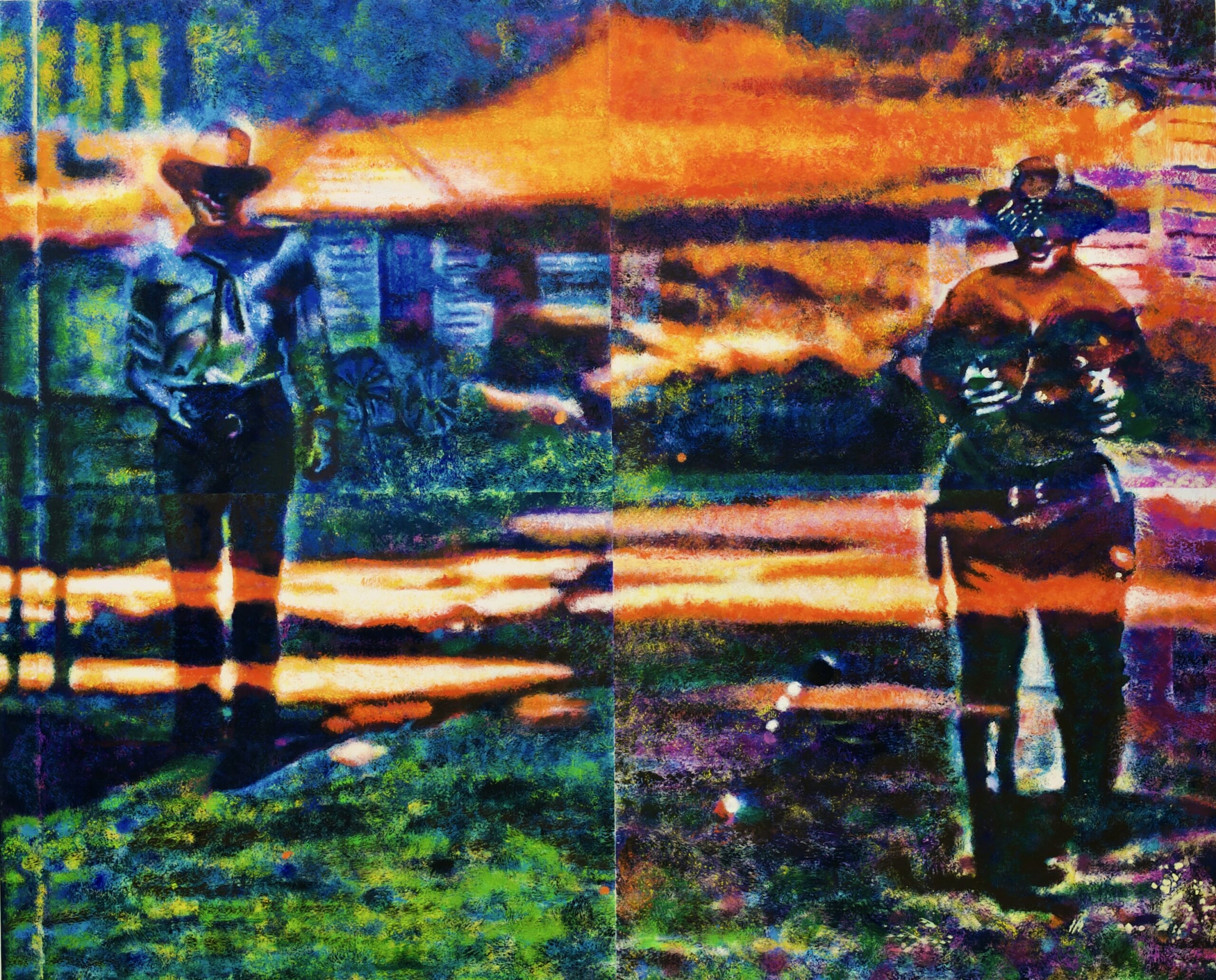
London based artist Bradley Richards makes figurative paintings by manipulating appropriated images in oil and acrylic paint. Developing an innovative approach to painting, the images, selected from photographs and film stills, are colourised, cropped, printed out onto paper, rephotographed and colorised again. They are then divided up into separate areas creating a fractured patchwork where the individual parts are painted separately as abstract planes. The final painting emerges with off register alignments between the separately painted areas, lines and colour created by the low-fi printout and reproduced digital artefacts. The aim is to disrupt how we see the painted image and allow for a deeper visual experience and emotional response. The work often obliquely references world events and directly draws from the historical archetypes. It is also informed by the artist’s work as a film editor and photographer.
Interview
How long have you had your present studio? In what ways is having a studio important to your practice or being an artist?
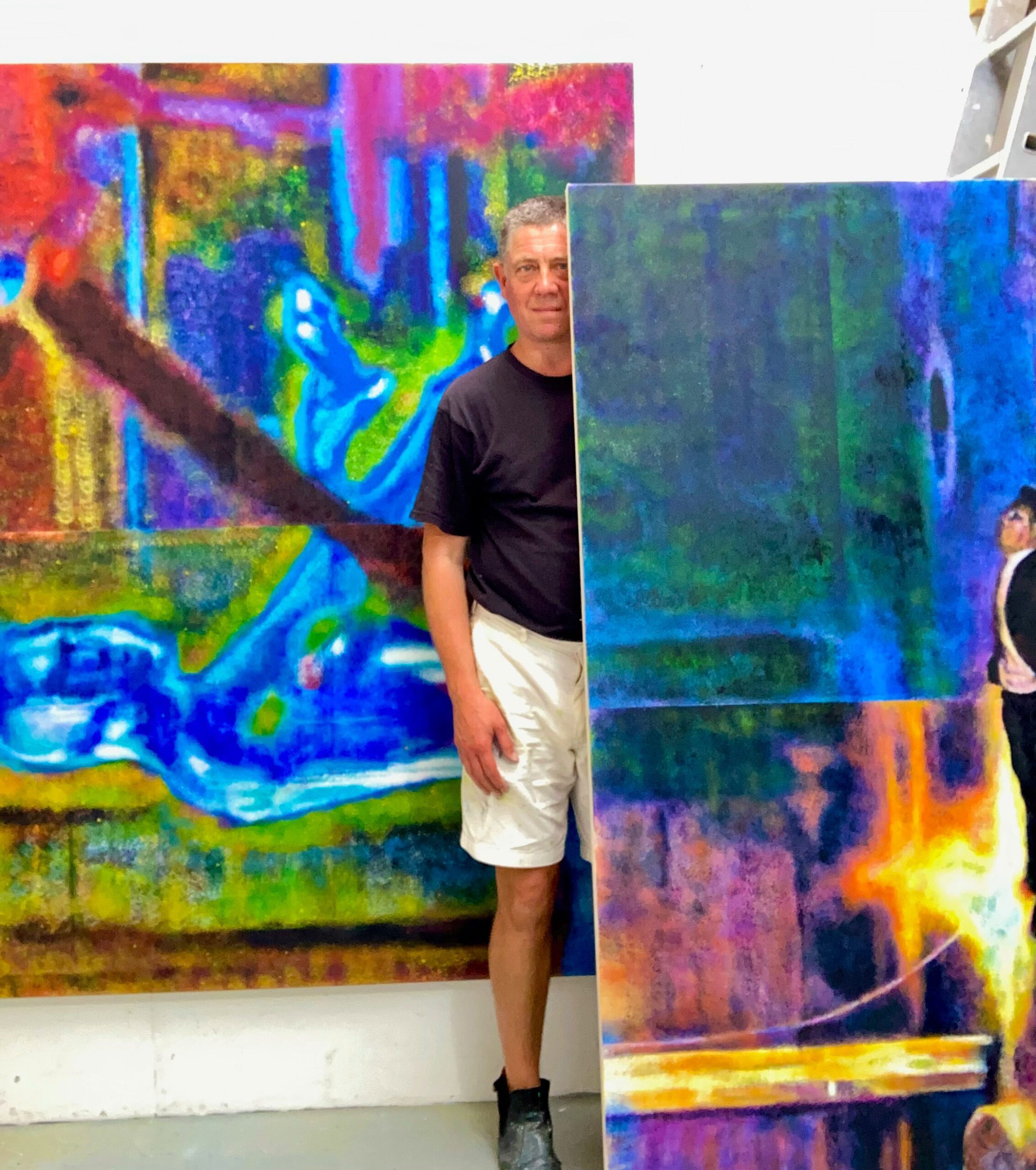
I have had my present studio since late 2022. My studio space has allowed me to create the kind of paintings that I always wanted to create. For a few years prior to getting the studio – and I must add this is my first – I was making paintings in my shed, so to go to a larger, light filled space with walls to hang work on and to have privacy and quiet, completely transformed my practice and the work came more easily. It has also in some way made the work feel more mature. I also think that having a dedicated space to paint in is essential for me to really focus and take the act of making the work seriously. This is hard to do if are in a more domestic environment.
What does a typical day or work session in your studio look like, how do you get to the studio? Do you have any rituals to warm up or close up?
I cycle to the studio in Streatham Hill from Brixton. I usually get to the studio around 11am sometimes later, but then I generally look at what I did the day before and try to assess what needs to be done further. Then I may work on a few things that I thought about overnight; small changes or notes I have made. I eat a small lunch in the studio, then I work until around 6 or 7pm. I also like a little background music going on, I find silence too much sometimes, and I think music can help me focus. I end the day with photos of the studio and the work, this gives me a guide to where we got to in the day and what to think about for the following day. If I don’t have paid work I usually try and work everyday in the studio. However if I can’t work, due to issues with ideas I stay at home and do things around the work, planning, looking, listening. I also think a rest day is really essential sometimes, going for a long country walk can really help with ideas.
How do you decide when to pursue an idea and when to abandon an idea?
When a new idea happens, I tend to get to work on it quickly, and if the idea is good, it usually happens quickly on the canvas too. Not a massive struggle, but that’s not always the case. I feel the idea is good when I see pointers towards the idea in other areas, it may be another artwork I happen to come across, or even a concept in a film, or a passing comment. These correlations are there all the time, but if our awareness is sharp to the idea, the universe will show us the way. When an idea has some of these things going on, and I take it to the painting stage, but it takes a long time to work, or if its gets ugly – muddy, I may lose confidence in the idea, then the energy drops off and I start to pick the painting apart – that’s definitely when to stop. I sometimes throw the canvas away, or make a new work on top. But when that ick hits – you can’t go on.

When you’re facing a creative block or struggling with your practice, how do you overcome it?
There is no rule to overcome a creative block, but I would definitely say that making something is better than nothing. And sometimes a small work or a different type of work can release you from your problems. Could be a drawing or taking some photos, or looking through old work, this can reconnect you with who you think you are, and in it you can see a new kind of love, and really you need to fall in love to make a thing. Also if you can’t finish a painting but most of it looks good, leave it to one side for a while. Then go back and decide what to do after working on something else.
How do other artists inform your work or what role does your immediate community of ASC artists play in the making of your work?
Engaging with other artists is really important to get perspective and also for tips of all kinds, and it’s good to have a bit of companionship from people who do similar work. Also to find out about private views and to discuss shows and new work of your own.
Whom do you seek feedback from in regards to your work? Why this person or set of people and in what ways have they shaped what you do?
The first person I try and ask about feedback from is my wife. Though she is not a painter, or artist, I trust she is going to be honest with me about the work. This feedback can then be weighed up, and I can decide what to do. It is hard to tell someone you don’t know intimately that you don’t like their work, so it’s best to start with someone you know is brutally honest with you. I also like to get a straw poll from anyone that I can get. Then according to what I feel about those people I can make a decision. If someone likes it lots maybe it’s totally wrong for me.
What do you wish there was more of in your neighbourhood or wider borough?
Project spaces are a really important thing, for artists and the community to experience the viewing of art and also the displaying of art projects from people who are not currently inside the art world/gallery system. It gives people the opportunity to experiment and challenge themselves to do something new, and it naturally encourages collaboration.
Through ASC you have access to a dedicated gallery/project space. In what ways has having this space been beneficial?
The Gallery/Project space is a fantastic thing. I recently organised a solo show of new work at Streatham Hill called Mercury In Retrograde. For artists who are new and emerging and don’t have a gallery, it’s perfect to hang your work in a professional looking space, not only to get a sense of what the work looks like in a gallery space, but to be able to curate the works in there and essentially to photograph them properly. Also for large paintings it is ideal to stand way back and look at them from a distance on a large white wall.
 What are some challenges you have faced as an artist along the way?
Ideas are always the most difficult challenge – to work through and finally commit to. On the surface there may be lots to choose from, but once boiled down and tested and sometimes even painted they can suddenly crumble and fall to nothing and there is always the gamble of whether the effort will pay off, or will you just feel disappointed and have wasted lots of paint. Another challenge I think for any artist possibly is to not get sidetracked and blown off course from your intention. You may start to think about pleasing a perceived audience, or trying to copy a style because it’s fashionable, and then you are far from making the work you really want to make.
If there was one creative person you could have dinner with from the past or present, who would you choose, why, and what kind of dinner would you plan?
There are several creative people it would be amazing to meet, but, I think Leonardo da Vinci would be my choice. He was a very inventive and thoughtful character and I’m sure it would be interesting for him to meet someone from the future to find out what had happened to the world and how some of his inventions and art work survived and informed our lives now. I was fascinated by the Mona Lisa when I was a child and it would be interesting to talk about that painting, how it has lasting appeal. Also maybe he could give advice to us on how to live well now, or what he thought about contemporary painting. I think I would make him a vegetarian curry and dhal with hand made chapatis, and have some good wine. I’m sure the curry would interest him as he may not have had access to such spices in sixteenth century Italy, but would be familiar with unleavened bread and wine.
Artist Specialty
Painting
Why not share this article?