
How Kim Shaw Built Success in ASC’s Project Space
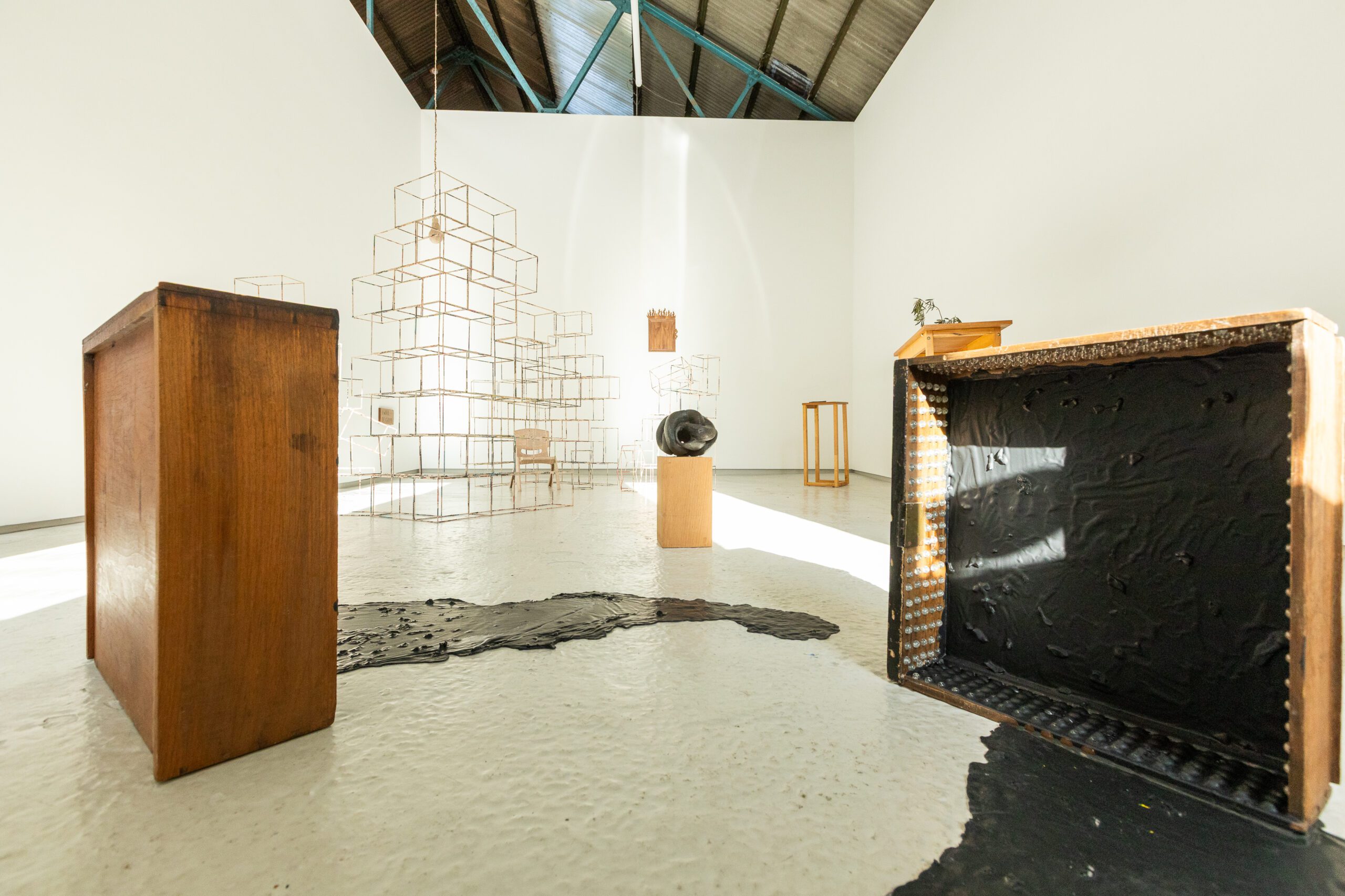
Earlier this year, artist Kim Shaw installed Corners, Pillars, Columns, a fragile, large-scale work made of 103 newspaper-wrapped wood bricks in our Streatham Hill Project Space as part of the group exhibition Streamwalking. That trial run didn’t just prove the ambitious structure was solid, it provided the vital install documentation that led to Kim being shortlisted for the Saatchi Gallery’s ArtEvol exhibition.
Below, Kim shares her experience in her own words.
Artist Bio
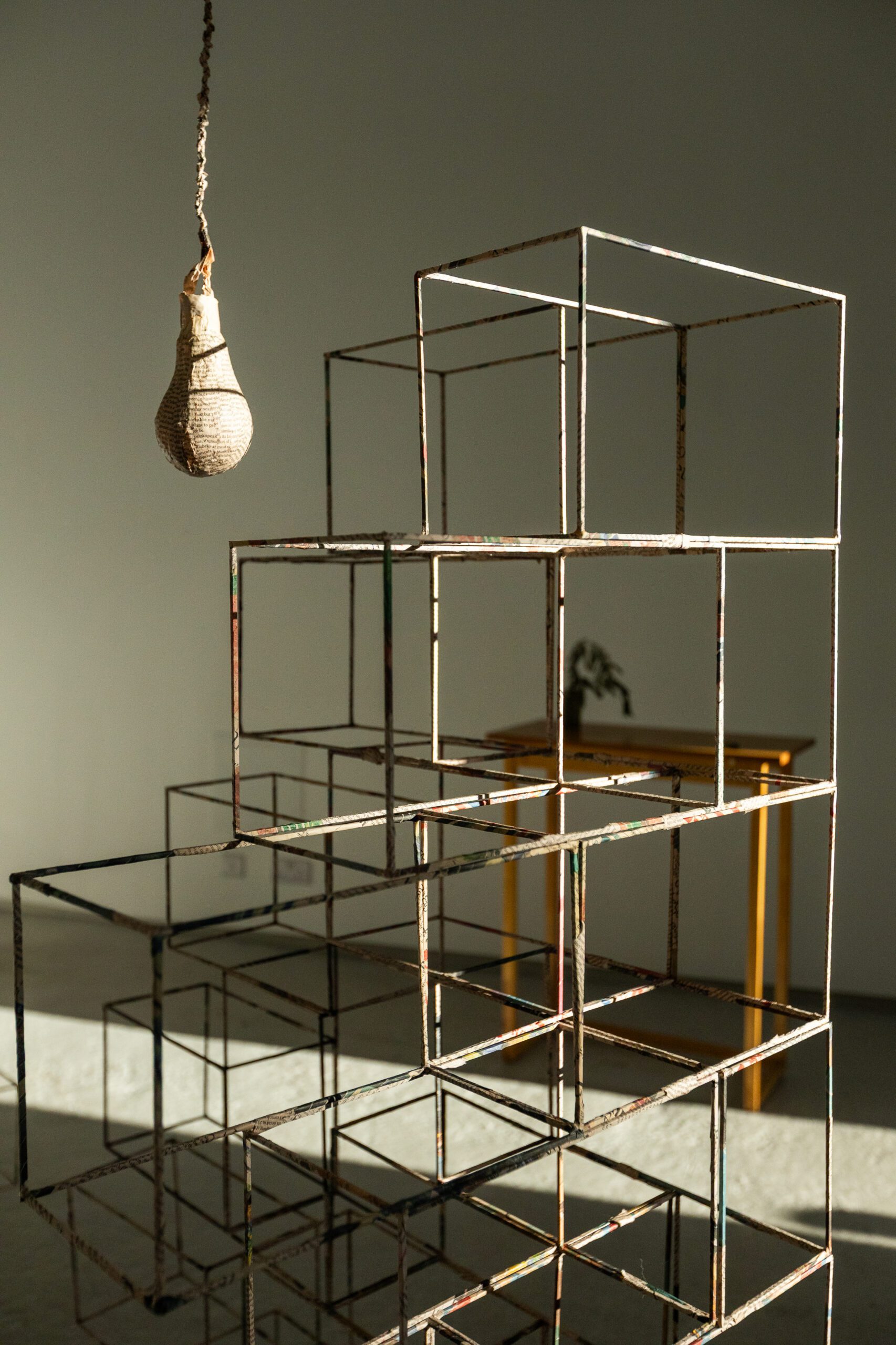
I am an American artist, based in London. In 2024, I completed my MA at Central Saint Martins in Contemporary Photography, Philosophy and Practice. While at CSM, my practice grew from being primarily photographic to an expanded practice including sculpture and installation. My work is informed by physics and philosophy, often exploring the paradox of isolation in a profoundly connected universe. The work itself is formed through accumulation and repetition. Repetitive “marks” connect and coalesce in three-dimensional space – the connections are fragile but the form is stable. My materials are either scavenged – 500 white moulted crab claws which form the sculpture “Pentimenti” – or they are inexpensive, often domestic items such as the hundreds of chopsticks that formed “Miss Scarlett” and the 100+ strip wood and newspaper “bricks” that form “Corners, Pillars, Columns.”
The Streamwalking Experiment
Over the past few years I’ve become more and more interested in artist led initiatives. To be clear, I don’t view artist-led initiatives as a sort of last resort. I am genuinely excited by what artists can achieve when the conventions of the artworld are kept at bay. In this case, Alex Stone, a friend and artist wanted to bring a small group together to read and discuss a text – Ursula K le Guin’s The Ones Who Walked Away from Omelas. The conversations around the text became conversations about making work and producing a group show. The Streatham Hill Project Space had recently gone live and I suggested that we apply to use it. As soon as our two weeks in May were approved, the project shifted to something real, somewhat urgent and very exciting.

Space to Take Risks
The Project Space presented a unique opportunity to take a risk. I had this idea of building the four corners of a room that sit at the heart of Omelas. In the story, the room is 2.25 meters x 1.5 meters. I built 103 “bricks” from 3mm strip wood which were wrapped in the Financial Times (wrapped in words, an important detail). These bricks were so fragile that I had no idea whether, when constructed, they would be robust enough to hold each other up or to withstand audience traffic. In addition, I had placed a child’s chair in one of the corners and had invited the audience to sit in this smallest of chairs. Again, no idea if the whole installation would come down like a house of cards. Or not, fingers crossed. So the risk as far as the work was concerned was big. But the project space mitigated that risk mainly because there is an understanding that it exists for exactly this type of experimentation. And, importantly, it’s free to use which takes some of the pressure off! We (Alex Stone, Sarah Davis, Irene Prisco) approached our project as we would have approached any exhibition – we were open for two weekends, had an opening party, a separate artist talk and we welcomed 100 guests and several dogs. And the best part was that the structure was solid. Even a very tall waggy tailed whippet didn’t bring it down!
From ASC to Saatchi
The two most important outcomes of the experiment in the Project Space were firstly, that “Corners, Pillars, Columns” got made. It’s the first large scale installation I’ve built and I was going to need a big space to work it out and assemble it. Second, I would have never had the information I needed to progress the work beyond Streatham Hill if I hadn’t had the opportunity to install it for a trial run. In the quiet hours, I played with lighting and another artist friend took proper install shots. A couple of months ago, someone who had seen the SH exhibition sent me the open call for the ArtEvol exhibition at the Saatchi Gallery, which I applied for. When I made my submission, I had great install shots and I was able to state that, while it appeared impossibly fragile, I had given the installation a trial run and it was stable. I hit the submit button feeling unusually confident- a new one for me! A few weeks later I received an email saying that I was shortlisted for the exhibition (another new one for me) and I would be featured in the exhibition catalogue. Alas, I didn’t make it into the final exhibition, but seeing the work acknowledged in the catalogue is a reminder of what a giant step forward this has been for my practice. Which brings me sort of full circle. The odds of ever making it to the final stages of the many, many open calls we spend our time (and money) on are not in our favour. But at least, no matter the result of this or that submission, I have made the work and I have brought it to an audience here in Streatham Hill.
Supporting London Artists
London is hard. And it’s expensive – very few of us can survive on income generated from our practice. Disappointingly, some of my favourite early and mid-career galleries, galleries I really wanted to be in, have recently closed. I don’t see it getting any easier in the near-term. This is why I have become so attached to the idea of artist-initiated projects. When we opened “Streamwalking,” we invited every curator, editor, academic and writer that we could think of. Some of them even came! And maybe some of them are still thinking about the work (fingers crossed). I’m really grateful that ASC has recognised that project spaces are essential if artists are to survive in this fragile ecosystem. Somewhere to network, find an audience, push the work, collaborate with other artists, and gather the information needed to move the work out into the world is a real lifeline. Most artists are masters of self-sufficiency, and the project space is a welcome opportunity to do what we do; namely, to just make it happen.
Learn more about Kim Shaw via her website & instagram

Why not share this article?