
Margaret Kerfoot
Artist Bio
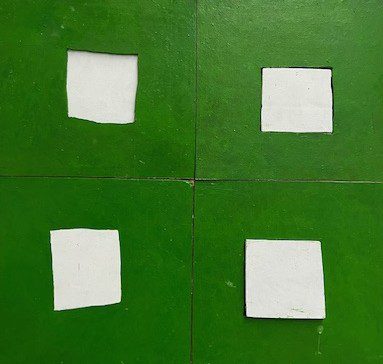
A South London based artist for the past 30 years, Margaret works in mixed media as an abstract and figurative artist. The Pennine landscape she grew up in has been a constant influence of her work over the past 70 years. She studied painting at Manchester College of Art graduating in 1970. Following college she returned to the North, working as an artist. Whilst she developed an abstract syntax in those early days, she always felt a connection with the landscape. The language she uses is the drawn mark whether it comes from a pencil, knitting wool, papier mache, or a 3-dimensional line of timber. In 2019 she exhibited with another painter Alison Shipton on a project where they collaborated in producing joint works. This is documented on the website ‘Back and Forth’ More recently solo work includes some large-scale 3D work reflecting the landscape. Recent work has focussed on simple geometric forms, lines, circles and squares on canvas, paper and free-standing objects. Her work is in private collections in the UK, she has exhibited many times, most recently at Copeland Gallery in Peckham and Margate Pie Factory.
Interview
What’s your favourite film?
“Cave of Forgotten Dreams” directed by Werner Herzog. [It is] a film about the Lascaux Cave Paintings. It was a very moving experience being introduced to these images. A magical, spiritual subject and a beautiful sensitively crafted film. 20,000 years ago, these cave paintings were representing a 3-dimensional world. For me this emphatically answers the question ‘Why do we create Art?’
Why do you make art?
As children we investigate the world around us: feel, play and make pictures. Sadly, in our culture many people grow up dissuaded from expressing themselves in this way. I make pictures to explore ideas, making marks. I enjoy the activity of making an object that can go out into the world.
What do you think you would be or do if you weren’t an artist?
I would be a footballer. As a 5-year-old, I knew what an artist was and I knew what a footballer was. I informed my parents I wanted to be both. With the support of mum, dad and brother, I did indeed do both. The physicality of striking the perfect ball or making the mark, offers up [to me] the same joy. I played for Oldham Athletic Ladies.
What is your earliest memory of making an artwork?
I grew up in the Pennines and spent my childhood playing in that landscape, soaking up its textures and forms. I have painted and drawn that landscape since I was 5; usually, little paintings and drawings which were completed quickly. However, I do remember spending 3 weeks on a painting during the summer holidays when I was 11. On my request I had been bought a studio easel and some oil paints. Over the next 3 weeks I painted a still life incorporating a rusty old mechanical lawn mower. I remember it well, the colour and the composition. I can recall many childhood pictures, the experiences of painting a subject over time, in oils and on an easel. I remember feeling very serious and focussed, as I do today.
What are some recurring subjects, images and/or materials in your practice?
Over the years [there have been] many iterations of themes and subjects:
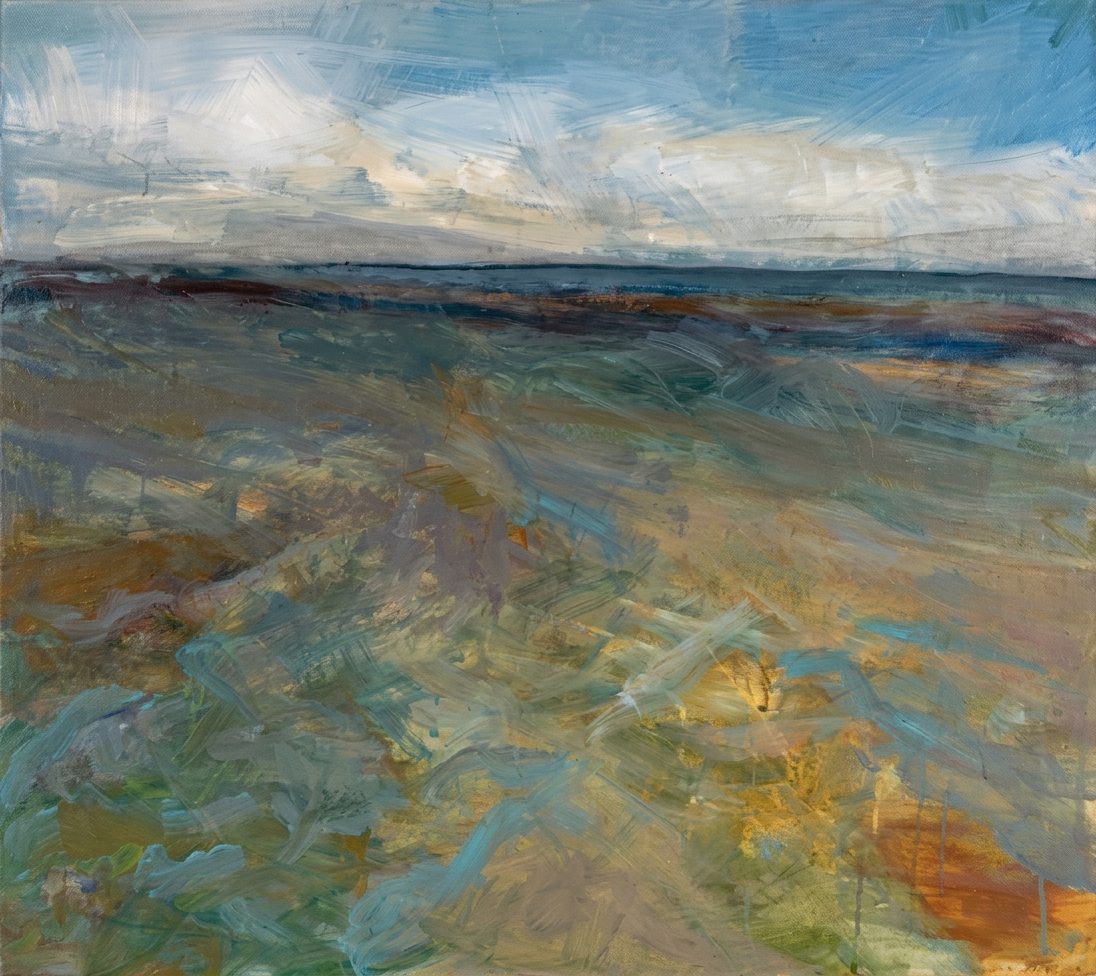
Land and seascapes; a preoccupation with the horizon, the defined and the less defined
Objects and shadows
Negative and positive shapes
Ambiguity and Absence
Focussing on lines as minimal expressions
Marks moving out of the picture frame
From the vertical to the horizontal, from the wall to the floor

Speaking of walls and flooring, do tell us about your studio. How long have you had it, for instance?
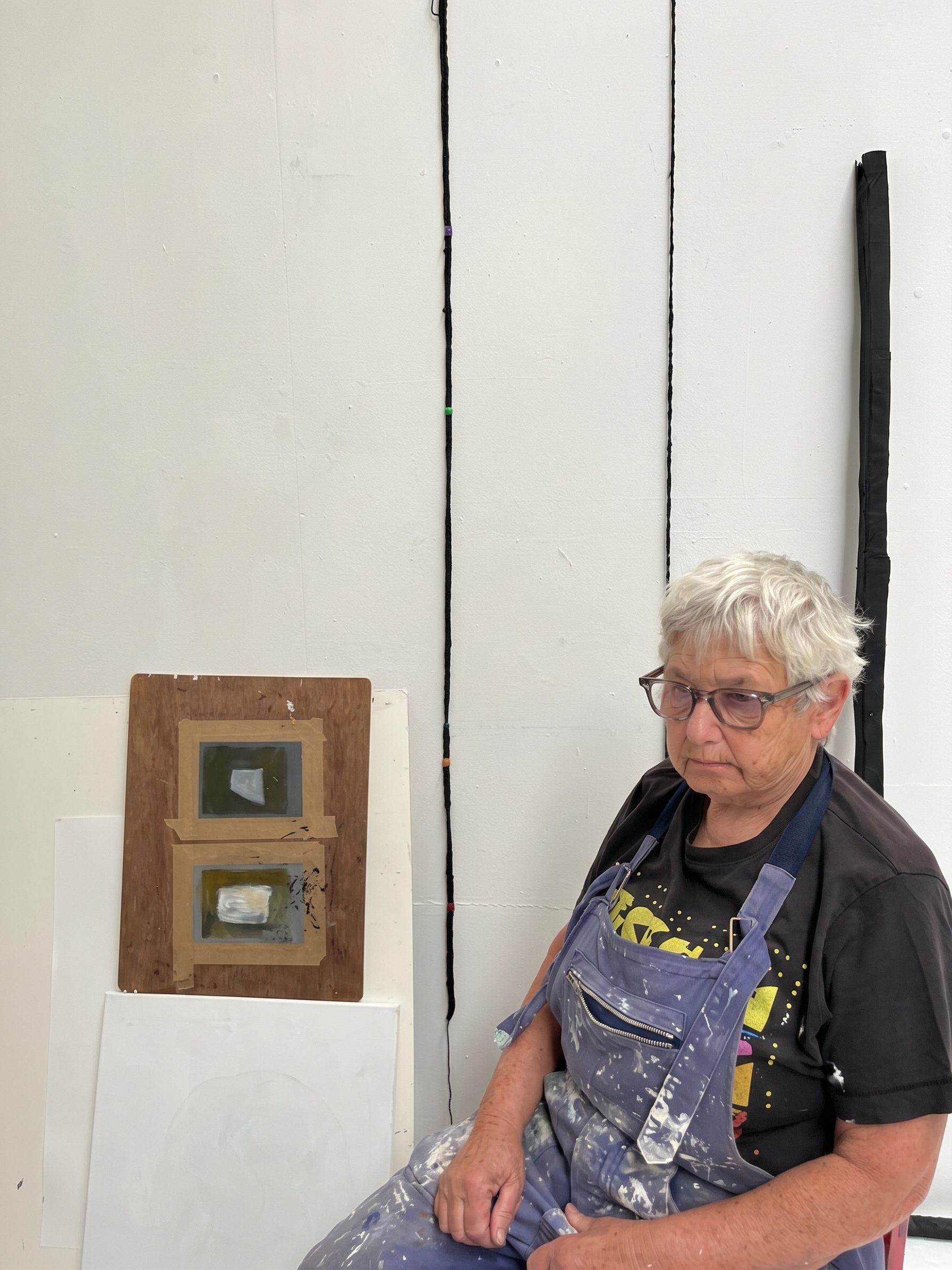
I have been at ASC since early 2024 and feel very fortunate in having my studio. I find it invaluable to have a dedicated space to do my work. The studio space enables me to create [in] an environment containing my tools, materials references, past and current work. Here I am able to immerse myself, explore and carry out work on a larger scale.
How do you usually get to and from your studio?
I travel to and from the studio by bus, occasionally by car if I have large things to deliver. It’s an uninterrupted single journey that gives me an opportunity to think about the day ahead. I try to structure my studio visits to go at least 4 days a week for 4/5-hour stints.
When you are facing a creative block, how do you overcome it?
Initially I try to understand what’s going on and not over complicate anything, I usually find that negative thoughts, anxiety and lack of confidence, cause an inability to create; the “why and what” get in the way. In the first instance I remind myself that making is a universal human pursuit and for me, its essence is play and discovery. To reaffirm this I do various things, I draw, spend time in nature, garden for physical exercise and stroke the cat. In the studio I will go through certain rituals of tidying up, and drawing [or] looking at past work.
What do you think are some challenges of being an artist in London?
Artists spaces have become more scarce as new developments have led to the loss of many workshops and gallery spaces. The affordability of artists’ spaces is always a challenge. More gallery/project spaces in London would be welcome.
What would you like to see more of in Lambeth or London that supports artists?
Local authorities have significant demands on very limited funds like children’s services for example. However, I think a way of making available cultural spaces, workshops/project spaces is to ensure that this provision of cultural spaces, workshops etc is made an essential criteria in any large scale planning application.
The ASC project space is one such. Have you used it recently or are planning to?
The project space is a great facility for seeing the work of the other artists. It is useful to see how they curate their shows, whether these are solo shows or group collaborations, I find it an opportunity for sharing ideas. I am planning a solo show later this year. I’m looking forward to curating my own show, and making decisions on how to occupy the space, [which] in itself will be of interest to me. The project space of course gives us all the opportunity to show new work to others.
In what ways would you say being part of a community of artists at ASC has informed your work?
Whether it’s meeting up with others, whilst making a cuppa in the kitchen, or on open days, visiting each other’s studios, sharing ideas, hearing conversations about work, seeing each other’s work is always fruitful.
What do you feel is the most human part of your creative process?
Problem solving. Making lone decisions whether it’s the right mark, whether or not a piece is finished. To express in making the world around you and realise your sensations. Despite the ups and downs, the Why and What for, feeling inquisitive and exhilarated, The physicality of mark making is exciting. Avoiding the pitfalls of gesture and repetition. Enabling the work and not promoting the ego.
If there was one creative person you could have dinner with from the past or present, who would you choose, why, and what kind of dinner would you plan?
I would choose Betty Parsons, painter, sculptor and visionary. As a pioneering American artist and visionary gallerist, she championed New York abstract expressionism whilst pursuing a parallel practice as a painter and sculptor. She gave her energy nurturing the careers of other artists, she gave Barnett Newman his first solo show and arranged early exhibitions of Agnes Martin. She supported and showed Rothko, Lee Krasner and many others. At the weekends she would go to her studio and produce her own paintings and sculptures. In later years she had a studio space on Long Island by the sea. How exciting and illuminating it would be to sit by the seashore sharing freshly locally sourced seafood, simple fresh ingredients; bread and wine while listening to the vast experience of her career and those of the others that she helped.
What museum, gallery or other cultural space do you frequent and why?
“To me there is no past or future in Art” said Picasso.
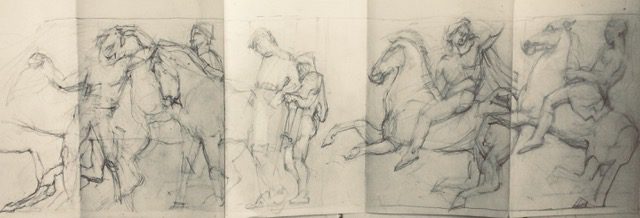
I am a regular visitor to exhibitions and permanent collections. Art from whichever period is alive today. My interests span different periods and mediums. I recently saw Nan Goldin’s “This will not End Well”, a retrospective of her videos and slide shows. I was informed and moved by their tenderness, a political piece of work, on many levels. I go to the Courtauld’s to revisit the Cezanne’s regularly, and also the National, or locally to Dulwich, I like to draw from the works of Titian and Rubens. My intention is not to make a reproduction, but to investigate the structure of the paintings and the sensual experience of interpreting the rhythms and layers. I try to see Pina Bausch dance productions when they come to London, visually exciting and witty. I have also drawn at the British Museum from the Parthenon frieze.
Artist Specialty
Mixed Media
Why not share this article?