Loretta Yussuff
Artist Bio
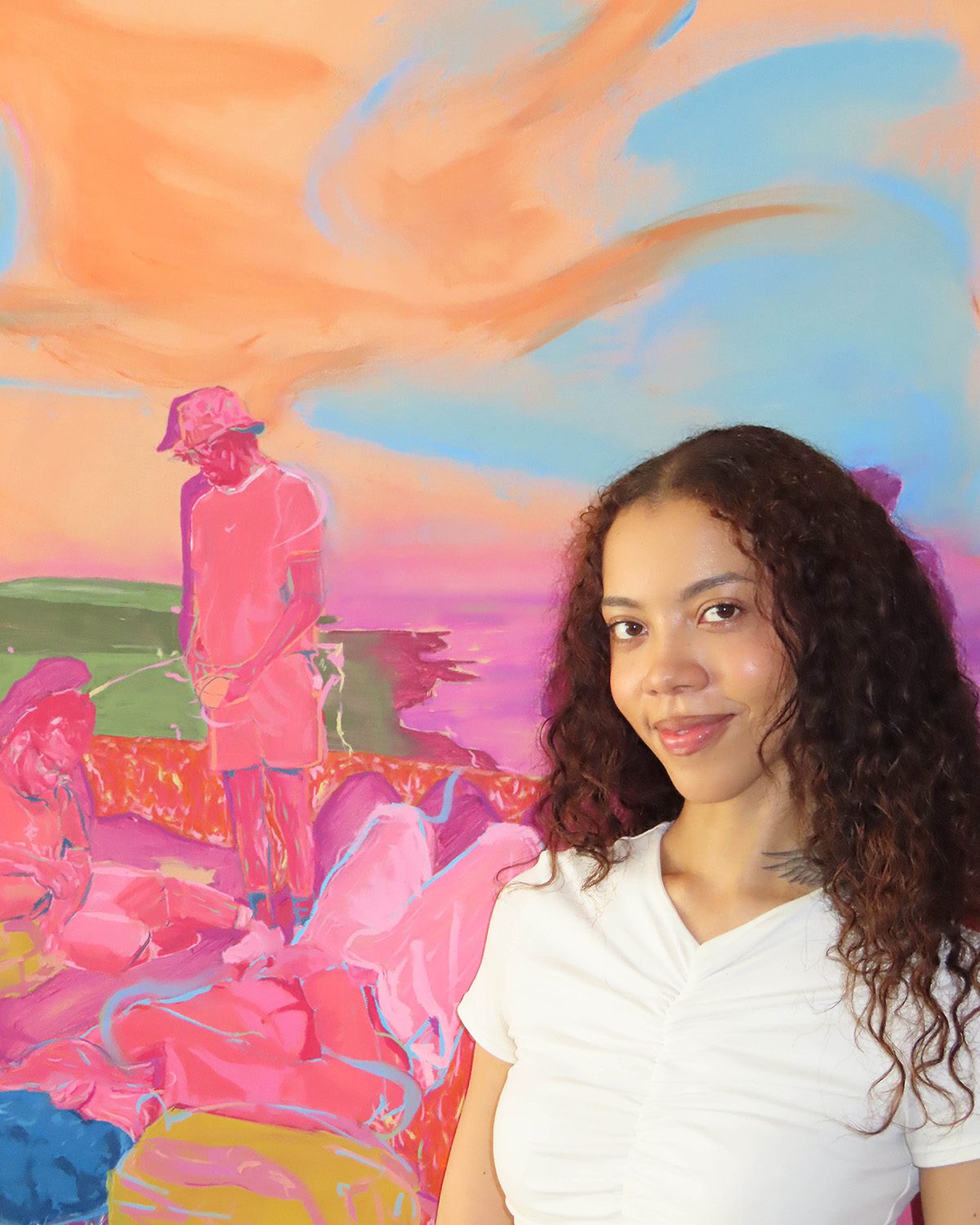
Loretta Yussuff is a British figurative artist of Nigerian–Lithuanian heritage. Her practice explores universal human emotions and psychological states through Black figuration, drawing on Christian and Western art traditions. Her work is characterised by rhythm and expressive colour, which play a central role in communicating both internal and communal experiences.
Loretta’s creative journey began in Fashion Design, graduating with a BA from the University for the Creative Arts in 2020. During a period of intensive self-education, she taught herself to draw from her bedroom, which served as her first home studio before going on to graduate from the MA Fine Art: Painting course at Camberwell College of Arts, University of the Arts London (UAL).
Interview
Tell us about yourself. Who you are, where you’re from and why you make art?
My dad is Nigerian and my mum Lithuanian. I grew up in Brixton in South London and studied Fashion Design for my BA. During my course I developed a love for painters as inspiration. I could not draw well at first, so began practicing more fashion illustration and then learning anatomy and perspective in my spare time. Once I got a grip on drawing I began painting small scale portraits and fell in love immediately with the painting process.
I had been encouraged earlier in life by my secondary school art teacher to continue to pursue art for GCSE’s but at the time it didn’t register to me and I preferred to study drama as my creative option. So painting has reentered my life in a beautiful way, after about 4 years of being self taught I went on to do an MA in painting at Camberwell College of Art and that has evolved my practice significantly..
I think I make art because I love it; it’s more of a passion than anything else and as soon as I found it, I felt like I’d discovered a missing puzzle piece of my life and I couldn’t see myself not painting. It’s something I enjoy the struggle of, and can see myself doing into old age.

What do you paint about and what kinds of materials or techniques do you use?
When I started painting in 2020 I had lots of bits of calico and thread from my fashion design course and so I started to stick them on pre-made canvases with gesso and create rhythmic oil painting portraits on top. A lot of the lines in the figures then and now I believe came from having been surrounded by threads and for me it visually represents complexity and aliveness.
I’m a figurative artist and very interested in the psychological worlds underneath everyday and private moments. I also use oil painting as a space to express the value in our emotional lives. Things like longing, dissociation, boredom, joy, connection are all important to me.
I sometimes use different materials with my work depending on the painting, for instance I incorporate gold or silver leaf frequently to represent the sacred, I use thread and sometimes plaster to bulk up elements of the paint.
Who are some artists you draw inspiration from? Are there others who use materials like cloth or thread in a way that you would like to be able to?
I draw inspiration from Van Gogh and from Golden Age Dutch painting. A new recent inspiration has been Eduard Vuillard’s domestic scenes during the early 1890’s which influenced my work ‘The Kiss’, Courbet’s A Burial At Ornans is something that I look at a lot for the work and the philosophy behind it. I recently went to see the opening of ‘Rules of Disappearance’ at Incubator Art Projects by Amelia Cross and that was really inspiring in the way that she uses garment construction to create paintings on canvas.
What about music or books or films? How do they, if at all, inform your work?
Music is huge for me in my process. It helps me create a specific mood while working that guides my colour choices for each painting. I have specific songs and playlists for specific artworks and sometimes I will listen to them on repeat while painting as a reminder of the mood that the work I want it to be imbued with. For example, when I was painting ‘The Lash Tech’ I created an R&B playlist because it reminded me of whenever I’m getting my eyelashes done, there is always R&B playing in the background and I wanted the painting to capture that feeling of that almost intimate setting of sitting in a chair and having someone work on your lashes. I generally listen to a lot of Lana Del Rey to work and other than that love reading Russian classic fiction stories, in particular Dostoevsky’s works and I have recently just finished reading War and Peace by Tolstoy. The way in which they are able to capture the inner workings of the mind and personalities I find fascinating.

What is your painting routine like? How often are you in the studio and do you have any starting or ending rituals when you are here?
I guess it depends on where the painting is at. I try to visit the studio at least two or three times a week. I work part time at Studio Voltaire and the Quentin Blake Centre for Illustration and so I’m here either on my days off or in the evenings after work or the gym. In terms of rituals, I’m quite a messy painter and so when I come to the studio, one of the first things I do is put on my sweatshirt and apron. Sometimes I also lay a cloth on the floor to make sure it stays clean.
In what ways do you think having a studio has changed or informed your practice?
Before this, I worked out of my bedroom on one small wall and was always nervous about getting paint on things, then I moved into a shared studio at Camberwell while I was studying for my masters degree, but now having my own lockable studio has been amazing. I find that because of it, I’ve been experimenting more; I’ve been working larger and using colours that are more saturated and vibrant.
What are you currently working on?
I have been developing a series of paintings for a joint exhibition called ‘Almost Together’ with my friend Cathalina who I shared a studio with at Camberwell during our MA Painting course. Having spent so much time together, we understand one another’s work really well and I have so much admiration for her paintings and her process and we have both wanted to do a show together for some time, so over the last six or seven months, we’ve been speaking over zoom every few weeks, I in London and she’s in Chile because she went back after our MA and we talk and share ideas and exchange journal entries and it has been really wonderful. We have a shared google drive in which we have been collecting ideas and over time realised that we have both been thinking about similar themes in different ways and that’s how this exhibition came about.

What are the themes you have been exploring and how do you each come at it differently in your ideas and paintings?
We realised that both of us have been thinking about the spaces in between people and the small moments that shape these. In my work, the figure is more front and center whereas in Cathalina’s newer work for the show the figure seems to recede into a beautifully painted landscape and vast skies. A series of her paintings, for example, is from an image she took of a person looking up at this expanse of sky that takes up most of the space on the canvas.I enjoy drawing people and they take up more of my frame spaces. But it’s all really still about those same small humane moments.
Why do you think people should come to see this exhibition?
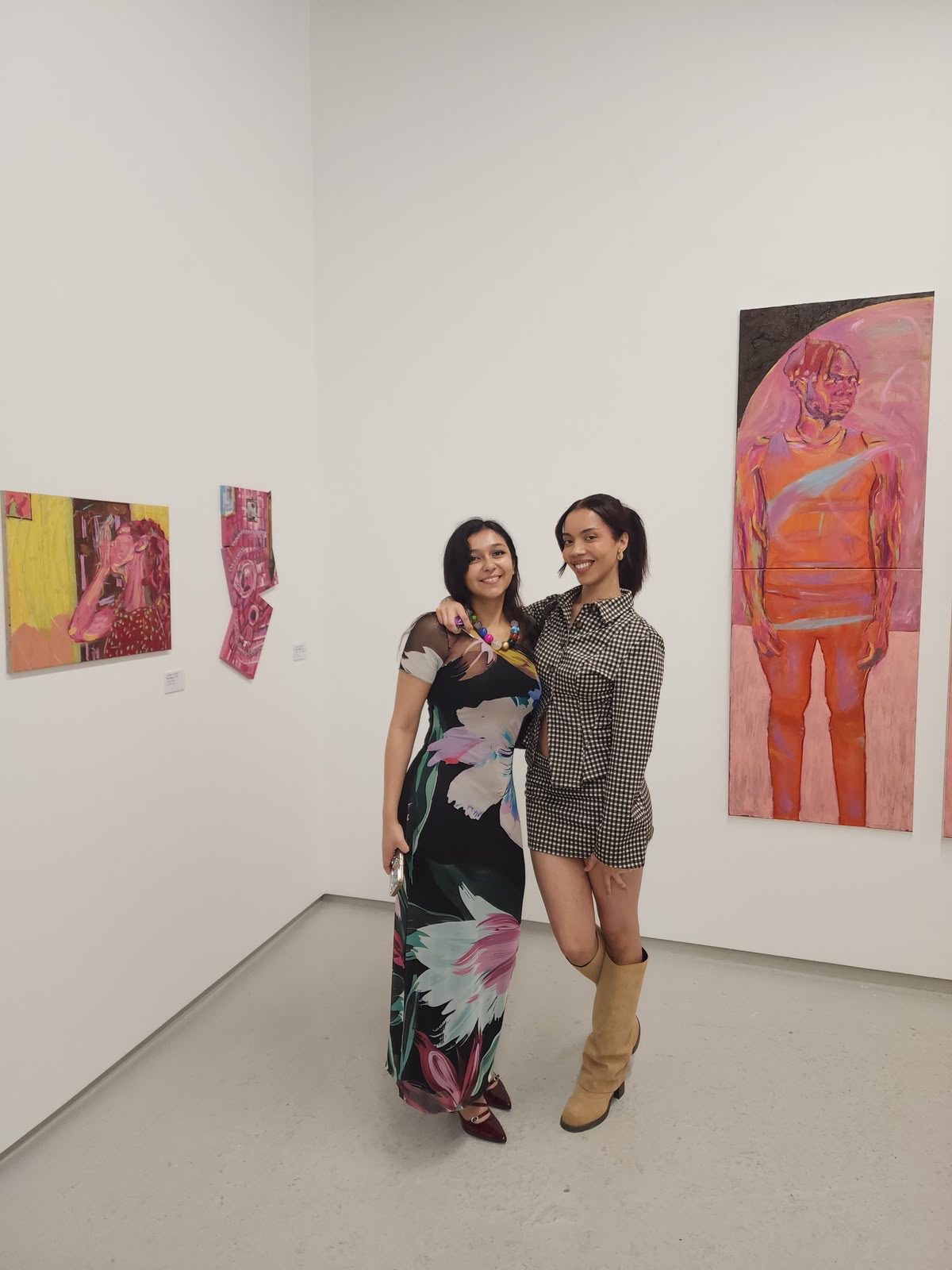
Because the paintings in this exhibition are very relatable. They speak to experiences we have all had or will have in some form or another, wanting connection yet not being able to fully connect with another person. There is also a reflection on those everyday moments from getting ready, to attending appointments, to looking at the sky, to resting with friends and I think it’s good to honour these moments in painting as we’ve done for the show.
What do you think is next for you? What are you looking forward to in the future?
Definitely further experimentation on ways that I can incorporate the canvas and manipulate it in ways that compliment the oil paintings I do. I am looking forward to seeing how the books I read, music I listen to and life experiences feed into my work to come.
Why not share this article?